
Auto-published by Growwh – a smarter way to scale content and marketing. Want to know more? Chat with us.
TL;DR: Haryana wants Rajiv Chowk as the RRTS start to boost all‑day ridership and multimodal integration. NCRTC warns of nearly Rs 2,000 crore extra cost, engineering challenges and NH‑8 disruption.
Overview: Rajiv Chowk push reshapes the Gurugram–Faridabad–Noida RRTS debate
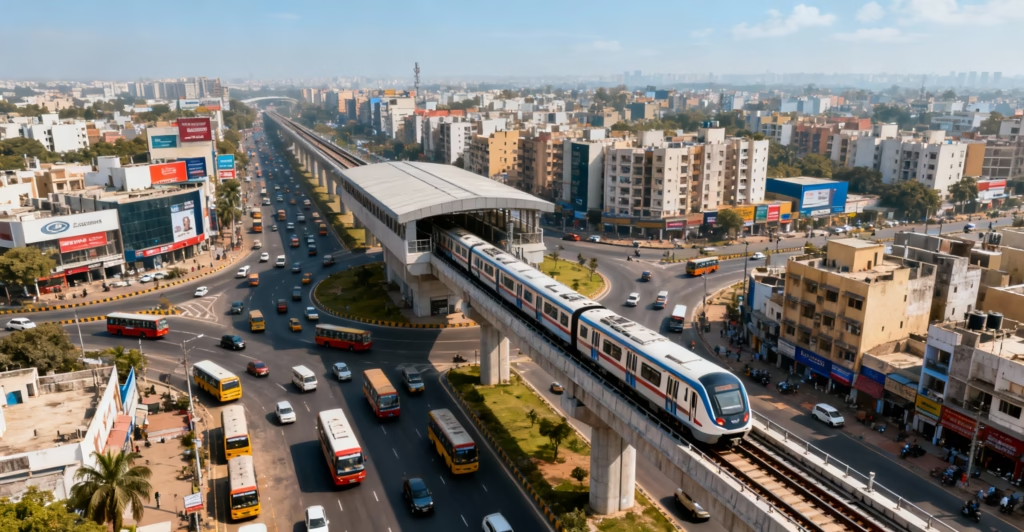
Haryana has proposed that Rajiv Chowk serve as the starting point for the new Gurugram–Faridabad–Noida Rapid Rail Transit System (RRTS) corridor. The plan aims to improve multimodal integration, increase all‑day ridership and create a stronger public‑transport catchment in Gurugram. The corridor is envisioned as a rapid airport‑to‑airport link connecting IGI Airport with Noida International Airport, passing through Gurgaon and Faridabad with six planned stations and an estimated project cost near Rs 15,000 crore.
Why Rajiv Chowk?
- Central connectivity: Rajiv Chowk sits at the geographic and transit centre of the city, linking Delhi–Jaipur highway, the Delhi–Mumbai Expressway and Sohna Road.
- All‑day ridership: Unlike IFFCO Chowk and Golf Course Road — which face concentrated corporate peak traffic — Rajiv Chowk serves dense residential, commercial and administrative clusters and a steady stream of commuters throughout the day.
- Interchange potential: Rajiv Chowk is already proposed as an underground station on the Delhi–Gurgaon–Manesar–Bawal RRTS corridor and could gain further metro and suburban rail connections, creating a major interchange hub.
The planning team argues that these factors could significantly lift daily ridership and strengthen last‑mile integration with city buses, metro lines and highway corridors. Such transit shifts also tend to affect property demand and micro‑markets around major interchanges — a dynamic similar to patterns seen when metro connectivity expands in strategic nodes like this. For more on how transit expansion can influence luxury and high‑demand pockets, see Delhi Metro Expansion: Luxury Property Hotspots?.
Alignment options, costs and engineering trade‑offs
The draft DPR outlined multiple alignment options with varying cost implications:
- An 11 km fully elevated alignment from IFFCO Chowk via Sector 54: estimated at Rs 2,858 crore for that segment.
- An underground + elevated option from IFFCO Chowk via Sector 53: estimated at Rs 4,180 crore—about Rs 1,322 crore higher than the initial elevated plan.
- An underground alignment starting from Rajiv Chowk via Sector 54: the costliest at ~Rs 4,825 crore, nearly Rs 2,000 crore more than the base alignment and raising the overall project budget.
NCRTC has flagged higher construction costs, complex engineering challenges and a potential disruption to NH‑8 traffic for up to three years if work is concentrated near Rajiv Chowk. The Haryana government counters that the marginal time impact for through passengers is small: at an operational speed of ~180 km/h, an extra 5 km translates to roughly one to two minutes of travel time but could deliver significantly larger ridership and integration gains.
Operational and commuter implications
Key operational points to consider:
- Travel time vs. catchment: High operating speeds mean small distance increases have minor time penalties but can unlock larger user bases.
- Airport connectivity: The corridor’s role as an airport‑to‑airport link (IGI to Noida International Airport at Jewar) makes station placement critical for long‑distance and transfer passengers.
- Urban impact: Rajiv Chowk’s proximity to hospitals, courts, administrative offices, industrial clusters and multiple residential sectors improves access for more trip purposes than a purely corporate node.
What this means for investors, residents and planners
Station siting will influence land values, development density and long‑term transport behavior across Gurugram and adjoining districts. Areas around Rajiv Chowk could see higher demand for transit‑oriented development, while alignment choices and construction phasing will determine short‑term disruption and costs. Investors and residents should weigh the potential for enhanced connectivity against the near‑term construction premium and traffic impacts. For a strategic look at how transport projects affect long‑term real estate returns and how to position portfolios for 2026, read Future-Proof Your Wealth: Indian Real Estate in 2026.
Urban planners must balance fiscal prudence with ridership optimisation: higher upfront expense for undergrounding in dense nodes can deliver superior integration and social benefits over decades, while elevated alignments may allow faster delivery with lower costs but less seamless interchange.
Next steps and wider context
The draft DPR discussions highlight a common debate in large transit projects: whether to prioritise lower immediate costs or to invest in deeper integration that maximises long‑term usage. The final alignment decision will require consensus between Haryana authorities and NCRTC, further engineering studies and stakeholder consultations, including traffic management plans for NH‑8 during construction.
For ongoing coverage, technical perspectives and commentary on how transport projects shape city landscapes and realty markets, visit the PropTrust Blogs section where planners and market analysts track updates and implications.
Quick facts
- Projected corridor cost: ~Rs 15,000 crore (total estimate).
- Station count (Gurugram–Faridabad–Noida section): 6 stations planned.
- Operational speed assumption: ~180 km/h.
- Estimated cost uplift if starting at Rajiv Chowk: nearly Rs 2,000 crore for specific alignment choices.
- Construction risk: potential NH‑8 traffic disruption up to 3 years for deep‑construction options.
As the debate progresses, stakeholders — commuters, developers, and city authorities — should track alignment decisions closely, since station siting at Rajiv Chowk could reshape travel patterns and real estate demand across Gurugram and the wider NCR.
This article was auto-generated as part of a smart content campaign powered by Growwh.com. Curious how we do it? Chat with us to learn more about our content automation systems.