
Auto-published by Growwh – a smarter way to scale content and marketing. Want to know more? Chat with us.
TL;DR: Tiered land subsidies of 30–50% for GCCs across Uttar Pradesh aim to spur investment and jobs.
Subsidies apply only on land bought from government agencies; mortgage and 12% recovery rules enforce timelines.
NRIs and investors should perform legal due diligence and plan for land acquisition and execution risks.
Uttar Pradesh rolls out land subsidy SOPs to attract GCCs
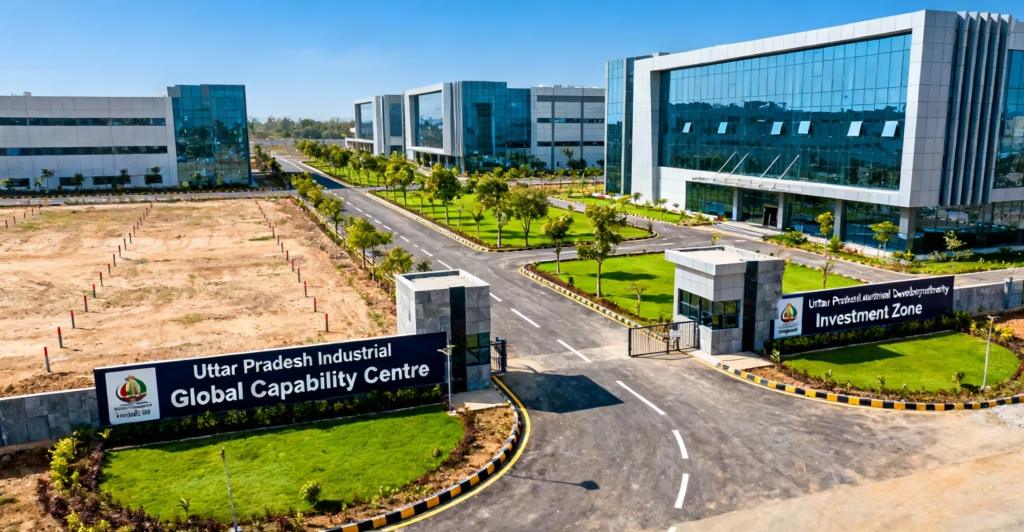
The Uttar Pradesh government has notified detailed standard operating procedures (SOPs) that offer front-end land subsidies to eligible Global Capability Centres (GCCs). The region-wise incentive framework — ranging from 30% to 50% — is designed to draw fresh investment, create high-value jobs and catalyse long-term infrastructure development across the state.
Region-wise incentives and eligibility
Under the new SOPs the subsidy structure is tiered by region:
- 30% subsidy for GCCs setting up in Gautam Budh Nagar and Ghaziabad.
- 40% subsidy for units in Paschimanchal (excluding Gautam Budh Nagar and Ghaziabad) and the Madhyanchal region.
- Up to 50% subsidy for GCCs established in Purvanchal and Bundelkhand to spur investment in underdeveloped areas.
Important eligibility rules: the subsidy applies only to land purchased from state industrial development authorities, development authorities, urban local bodies or other government agencies. Units operating from rented premises or co-working spaces are ineligible, since the policy targets the creation of long-term industrial infrastructure.
Safeguards, timelines and fiscal mechanics
The SOPs include clear safeguards to ensure timely project execution. Allocated land will remain mortgaged with the concerned authority until commercial operations begin or the stipulated period ends. If projects are delayed or remain incomplete, the subsidy amount will be recovered with a 12% annual interest charge. The department of industrial development will bear the subsidy cost on behalf of the state.
What this means for GCCs and investors
For multinational enterprises and GCCs evaluating India locations, these SOPs make large parts of Uttar Pradesh more competitive on a landed-cost basis than before. Higher subsidies for Purvanchal and Bundelkhand are specifically intended to reduce regional disparities and encourage dispersal of jobs and economic activity beyond established hubs like Noida and Greater Noida.
Key investor takeaways:
- Substantial upfront land support can materially lower set-up costs, but only when buying from government agencies.
- Mortgage conditions and recovery clauses mean timelines and milestones must be closely managed to avoid subsidy clawbacks.
- Rented or flexible workspace strategies will not qualify — firms seeking subsidies must plan for land acquisition and long-term infrastructure investment.
Opportunities for regional development and jobs
The policy aims to attract headcount-expanding GCCs that deliver high-value services such as engineering, R&D, analytics and technology operations. By tying incentives to specific regions, the state hopes to channel employment generation to underdeveloped districts while encouraging private investment in roads, utilities and commercial campuses.
Risks and compliance considerations
While the subsidy is attractive, investors should assess project execution risks, land title clarity, and milestone timelines. The mortgage and recovery provisions mean that a compliant governance framework — from construction to commercial operations — is essential to secure and retain benefits.
Practical next steps for investors and developers
Developers and GCCs evaluating Uttar Pradesh should:
- Map eligible land parcels with state agencies and confirm the subsidy quantum for the target region.
- Build conservative project schedules and contingency buffers to prevent subsidy recovery triggers.
- Engage legal and transaction advisors early to verify land purchase documentation and mortgage conditions.
NRIs and international investors can also benefit from additional guidance on compliance and transaction safeguards — consider reviewing resources on legal due diligence for NRI property buyers in India as you plan acquisitions and partnerships. For strategic market intelligence tailored to overseas investors, explore NRI Realty Edge insights. And for a longer-term perspective on property allocation and wealth planning, read guidance on future-proof your wealth: indian real estate in 2026.
Bottom line
Uttar Pradesh’s SOPs for GCC land subsidies create a strong incentive to bring Global Capability Centres to the state, especially in Purvanchal and Bundelkhand where subsidies are largest. The programme balances attraction with accountability through mortgage and recovery safeguards. For companies and investors, the policy presents a major opportunity — provided project planning, legal due diligence and execution discipline are prioritised.
Keywords: Uttar Pradesh GCCs, land subsidies, Global Capability Centres, Purvanchal, Bundelkhand, Gautam Budh Nagar, Ghaziabad, jobs, investment, industrial infrastructure.
This article was auto-generated as part of a smart content campaign powered by Growwh.com. Curious how we do it? Chat with us to learn more about our content automation systems.