
Auto-published by Growwh – a smarter way to scale content and marketing. Want to know more? Chat with us.
TL;DR: A Noida software engineer died after his car fell into a water-filled construction pit; a real estate director has been arrested. A three-member SIT will probe the incident and submit findings within five days, focusing on developer negligence and civic accountability.
Noida techie death has triggered widespread outrage after a 27-year-old software engineer’s car plunged into a water-filled construction pit in Sector 150. Authorities arrested a director of a real estate firm and formed a Special Investigation Team (SIT) to determine the causes and accountability. The SIT has been given five days to submit its findings.
What happened: timeline and rescue efforts
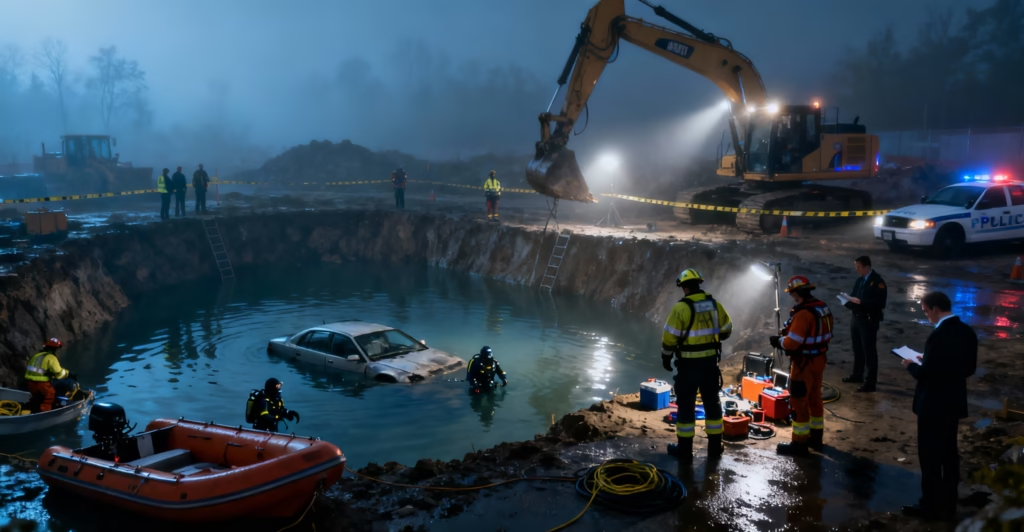
The incident occurred on a foggy night when the vehicle skidded off the road, broke through a boundary, and sank into a deep, waterlogged pit dug for the basement of an under-construction commercial complex. Eyewitnesses say the victim, Yuvraj Mehta, repeatedly called for help for nearly two hours before rescue teams recovered the body following prolonged search operations involving the fire department, police, State Disaster Response Force (SDRF) and National Disaster Response Force (NDRF). Reports indicate that expert divers and boats were later used to locate and retrieve the submerged car.
Arrests, FIR and legal implications
Police arrested a director of one of the involved firms and have filed an FIR under provisions including culpable homicide not amounting to murder and causing death by negligence. Investigators are examining whether safety protocols, site demarcations, and emergency-response systems were adequate or ignored. The FIR names two development firms and alleges negligence by both developers and local authorities.
SIT probe: scope and timeline
The specially constituted three-member SIT—led by senior regional law-enforcement and public-works officials—has inspected the site and met with Noida authority representatives. The panel will examine the roles of civic agencies, police and rescue services, and will interview witnesses and family members. Officials say the SIT’s written report is expected within five days and will outline culpability and recommendations for preventing similar tragedies.
Accountability, public reaction and governance
Public anger centers on alleged lapses in site safety, delayed rescue response and inadequate barricading around deep excavations. Critics call for stronger enforcement of construction safety norms and clearer accountability for developers and civic bodies. The incident has also sparked calls for systemic reforms to ensure timely rescue capabilities and better on-site supervision.
What this means for buyers and investors
For property buyers and investors—especially those considering Noida and surrounding NCR micro-markets—this case underscores the importance of stringent pre-purchase checks and ongoing developer accountability. Non-resident Indian (NRI) investors should pay particular attention to compliance and on-the-ground safety records; clear guidance is available on legal due diligence for NRI property buyers in India that outlines documentation, approvals and red flags to watch for.
As Noida continues to attract development interest, including from NRIs, it’s wise to consult targeted resources such as NRI Realty Edge: insights for NRIs investing in Indian real estate for investment-readiness and risk-awareness tips. Awareness of developer track records, site safety measures and emergency preparedness can be as critical as pricing and location.
Noida growth, infrastructure and risk hotspots
Rapid urban development and major infrastructure projects—like metro extensions—shape demand and create new hotspots, but they also bring construction-related risks in fast-expanding corridors. If you’re watching opportunities in the region, consider data-driven overviews such as the analysis of Delhi Metro expansion and Noida property hotspots to balance growth potential against construction safety and regulatory scrutiny.
Practical safety and policy recommendations
- Enforce visible, durable barricades and warning lights around all deep excavations, especially near roads and drains.
- Mandate site-level emergency-response plans and trained first responders for active construction zones.
- Require developers to publish safety compliance certificates and incident histories for major projects.
- Improve coordination protocols among civic agencies, police and disaster-response units for faster on-site action.
Next steps and what to watch
The SIT’s five-day report will be pivotal: it should clarify legal responsibility, highlight procedural lapses and recommend enforcement actions or policy reforms. Follow-up actions may include criminal prosecutions, administrative penalties for authority officials, and tighter site-safety norms. Meanwhile, prospective buyers and community stakeholders should insist on transparency from developers and local authorities about safety and compliance records.
This tragic event serves as a stark reminder that urban expansion must be matched by robust governance, proactive safety practices and clear accountability. For those investing or living in fast-developing areas, due diligence and vigilance remain essential to minimize risks and hold stakeholders responsible when failures occur.
This article was auto-generated as part of a smart content campaign powered by Growwh.com. Curious how we do it? Chat with us to learn more about our content automation systems.