

Auto-published by Growwh – a smarter way to scale content and marketing. Want to know more? Chat with us.
TL;DR: Noida Authority formed an eight-member committee to clear backlog of unregistered tripartite sub-lease deeds, protect revenue and regularise ownership.
Affected flat owners, buyers and cooperative societies should prepare documents, seek legal advice and monitor the committee’s recommendations closely.
Overview
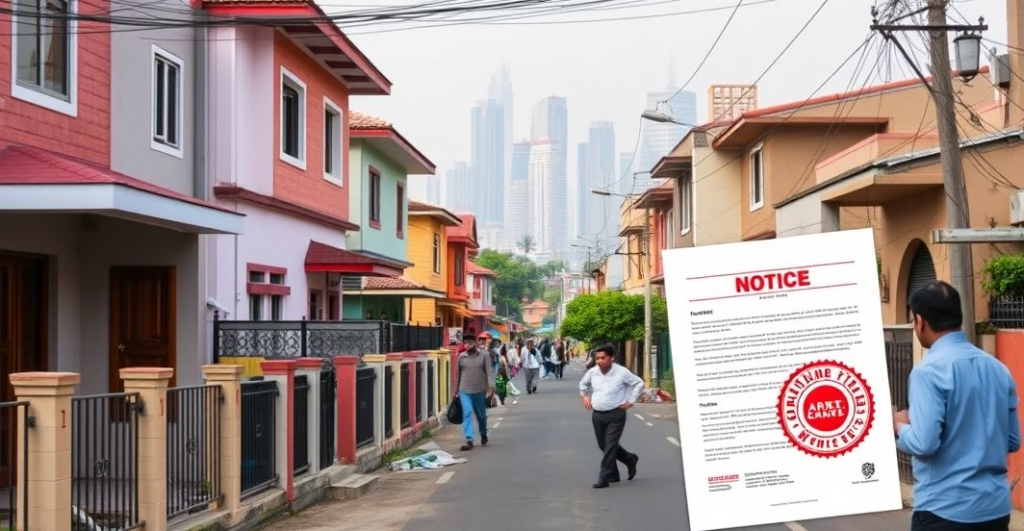
Noida Authority has constituted an eight-member committee to tackle the long-standing backlog of unregistered tripartite sub-lease deeds for flats built on group housing plots. The move aims to protect the Authority’s financial interest, regularise ownership for subsequent buyers, plug revenue leakage from unpaid stamp duty and potentially create a uniform policy for registration in cooperative housing cases.
Committee mandate and composition
The committee, chaired by the Additional CEO (Group Housing), includes the chief legal advisor, financial controller, officer on special duty (group housing), assistant inspector general (stamp) of Gautam Budh Nagar, general managers for planning and civil, and the manager or AGM (group housing). Its mandate is to examine the legal, financial and administrative complications arising from non-registration of tripartite sub-lease deeds and submit actionable recommendations.
Why sub-lease deeds matter
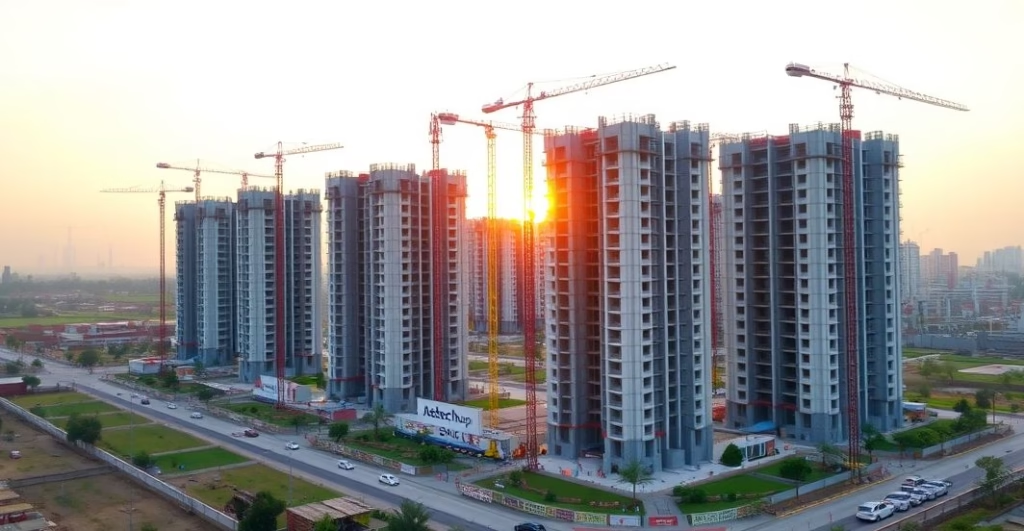
When group housing plots are allotted to cooperative societies, the Noida Authority’s condition has been to execute tripartite sub-lease deeds in favour of individual flat allottees after construction, payment of dues and issuance of occupancy certificates. In many cases, original allottees sold flats without executing sub-lease deeds or paid only nominal charges; in other cases transfers occurred via GPA or SPA with changes recorded only in society books. That gap has led to legal uncertainty for subsequent occupants, administrative hassle for societies, and revenue loss to the state from unpaid stamp duty.
A notable instance prompting renewed focus was a submission from the Air Force Naval Housing Board listing 729 flats in Sectors 21 and 25 where sub-lease deeds were not executed in favour of current occupants. The panel may consider allowing direct execution in favour of current occupants on payment of prescribed charges to regularise these cases.
Impact on owners, buyers and cooperative societies
- For original allottees: Delay or failure to execute sub-lease deeds exposes them to future disputes and limits clear title transferability.
- For subsequent buyers: Lack of registered sub-lease deeds creates title risk even if societies have issued NOCs or recorded ownership changes.
- For cooperative societies: Societies may face administrative burdens and legal exposure if transfers are not properly documented through sub-leases.
Currently, Noida Authority permits execution of sub-lease deeds only in favour of the original or first allottee, subject to delay charges. The committee’s recommendations could pave the way for a pragmatic mechanism to allow registered sub-leases in favour of current occupants on payment of prescribed charges, while safeguarding Authority revenue.
Practical steps for affected homeowners and buyers
- Gather original allotment documents, occupancy certificates, society NOCs and sale instruments such as GPA/SPA.
- Request the cooperative society to provide certified records of ownership changes and NOCs where applicable.
- Be prepared to pay prescribed delay charges and stamp duty if the Authority’s panel recommends regularisation routes.
- Consult a conveyance or property lawyer to assess title risk before buying or selling a flat with an unregistered sub-lease.
Special considerations for NRIs and distant investors
NRIs and out-of-town buyers should exercise extra caution. Missing sub-lease registrations can complicate resale, financing and title insurance. It is prudent to conduct focused legal checks and documentation reviews tailored to non-resident investors’ needs; start with a structured checklist such as Legal due diligence for NRI property buyers in India and complement that with broader market guidance found in NRI property insights.
Market outlook and infrastructure linkages
Regularisation of sub-lease deeds and clarity on titles can improve market confidence in affected sectors and encourage transactions. Infrastructure upgrades and transit expansion tend to amplify demand and price resilience; for instance, broader transit projects such as metro expansions often shift buyer interest toward well-connected neighborhoods. For context on how transit development shapes premium pockets, see analysis on Delhi Metro expansion and luxury property hotspots.
What to watch next
The committee’s recommendations will determine whether Noida moves to a one-time regularisation window, permits sub-lease execution directly in favour of current occupants, or tightens compliance strictly for original allottees. Homeowners, societies and buyers should monitor official notifications, collect documentary evidence now, and consult legal counsel to be ready for any prescribed process.
Bottom line
The Noida Authority’s panel represents a decisive step toward resolving decades-old registration gaps that have created title uncertainty and revenue loss. Clear policy changes could unlock transactions, protect buyers and ensure rightful stamp duty collection—but affected parties must act now to gather records and seek legal clarity.
This article was auto-generated as part of a smart content campaign powered by Growwh.com. Curious how we do it? Chat with us to learn more about our content automation systems.