
Auto-published by Growwh – a smarter way to scale content and marketing. Want to know more? Chat with us.
TL;DR: Draft DPR proposes a six‑station Gurugram–Noida RRTS (IFFCO Chowk–Surajpur) at ~Rs 15,000 crore. Key debate: elevated viaduct vs underground alignment through Gurugram.
Overview: What the Gurugram–Noida RRTS DPR proposes
The draft detailed project report (DPR) submitted to the Haryana government maps a new rapid rail corridor between IFFCO Chowk in Gurugram and Surajpur in Greater Noida. The corridor proposes six stations and an estimated cost of around Rs 15,000 crore. Designed to bypass central Delhi, the corridor aims to strengthen long‑term connectivity between IGI Airport and the upcoming Noida International Airport at Jewar by linking with other proposed RRTS lines.
Route, stations and travel times
The proposed alignment runs via Sector 54 in Gurugram, enters Faridabad at Bata Chowk, moves through the Sector 85–86 intersection and proceeds towards Noida sectors (142/168) before terminating at Surajpur. The corridor is planned to connect with the Delhi–Bawal corridor at IFFCO Chowk and with the Ghaziabad–Jewar corridor at Surajpur, creating an integrated RRTS network across NCR.
Projected travel times are transformative: an RRTS ride from IFFCO Chowk to Faridabad would take about 22 minutes and to Noida about 38 minutes, significantly reducing intercity commute times across the National Capital Region.
Elevated vs underground: the core debate
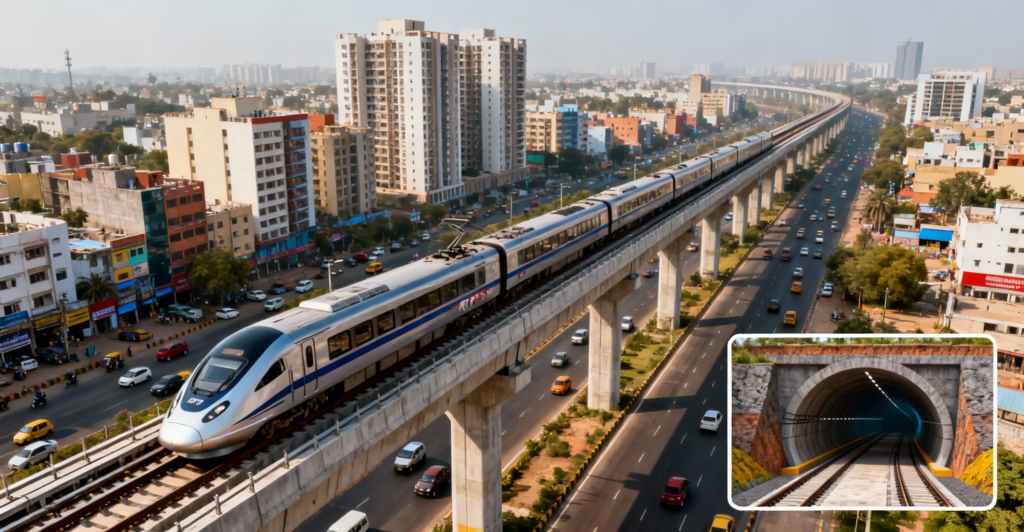
While NCRTC has designed the corridor largely as an elevated line, the Haryana government has pushed for an underground alignment through Gurugram. The state’s argument centers on high land costs, dense urbanisation and the need to preserve surface space for future road and mobility upgrades—flyovers, multilevel junctions and pedestrian infrastructure. Officials warn that elevated viaducts along arterial roads could permanently limit surface‑level upgrades and cause prolonged traffic disruptions during construction.
Mobility consultants stress that the decision is ultimately about cost, right‑of‑way and urban context rather than technology. Multiple, well‑placed stations are critical to attract commuters away from private vehicles—limited stations with sparse catchment areas will not shift travel behaviour.
Network context: Haryana’s expanding RRTS map
This corridor will be the third major RRTS plan traversing Haryana. Two other corridors—Delhi–Gurugram–Manesar–Bawal and Delhi–Panipat–Karnal—have advanced through approvals and await final clearances. The new Gurugram–Noida link is being planned in coordination with central and state agencies to align with IGI–Jewar connectivity strategies and future urban growth corridors.
Real estate and commercial impact
Fast, reliable regional connectivity typically shifts real estate demand and creates new development hotspots. For buyers and investors watching NCR property trends, improved RRTS links are likely to lift demand for residential projects near station catchments and boost premium micro‑markets. You can read more about how metro and rapid rail expansions are shaping high‑end demand in the region in Delhi Metro expansion and luxury property hotspots in NCR.
Improved commuter rail also spurs demand for modern retail and office spaces near transit nodes. Projects such as Sikka Mall of Noida on Noida Expressway and Orion One32 retail and office spaces in Noida Sector 132 exemplify the kind of mixed‑use and commercial developments that benefit from enhanced regional connectivity and large commuter catchments.
Stakeholder positions and next steps
The DPR has been circulated for feedback among stakeholders including Haryana government bodies, NCRTC, municipal agencies and transit authorities. Discussions will focus on optimal station spacing, corridor alignment through Gurugram, and integration with other planned RRTS lines. Final decisions will balance capital cost, land acquisition challenges, construction impact and long‑term urban planning needs.
What to watch for
- Final alignment decisions (elevated vs underground) and the number of stations within Gurugram.
- Integration milestones with Delhi–Bawal and Ghaziabad–Jewar corridors that will determine airport connectivity to IGI and Jewar.
- Approvals and funding clearances that will move the project from DPR stage to implementation.
As the region plans for higher‑speed, higher‑capacity regional rail, residents, developers and urban planners should track the DPR consultation outcomes closely—these choices will shape commuting patterns, urban form and property demand across the western and eastern corridors of the NCR.
This article was auto-generated as part of a smart content campaign powered by Growwh.com. Curious how we do it? Chat with us to learn more about our content automation systems.