
Auto-published by Growwh – a smarter way to scale content and marketing. Want to know more? Chat with us.
TL;DR: NBCC will petition the Supreme Court for a RERA exemption to divert funds and raise finance to complete 11 cash-starved Supertech projects. The company aims to resume work quickly and complete the portfolio within up to three years, balancing delivery timelines with buyer protections.
Why NBCC is approaching the Supreme Court for a RERA exemption
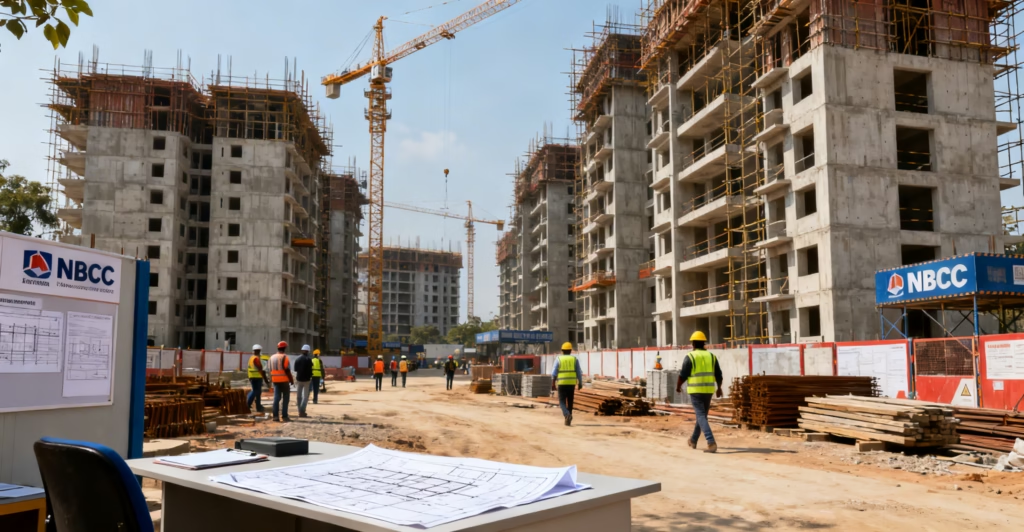
State-owned NBCC has decided to approach the Supreme Court for an exemption from RERA registration and restrictions so it can divert surplus cash and raise external funds to complete 11 of 16 stalled Supertech projects that require fresh capital. After a review of the portfolio it agreed to take over, NBCC concluded that several projects will need cross-financing or external borrowings to meet construction and delivery timelines—moves that current RERA rules constrain.
Quick facts at a glance
- Total Supertech projects NBCC asked to take over: 16
- Projects requiring fund infusion where exemption is sought: 11
- Total homes across the 16 projects: 50,962
- Sold homes: 39,870 (24,871 delivered; 14,999 yet to be delivered)
- Estimated investment to complete sold homes: Rs 1,700 crore; expected receivables: ~Rs 2,200 crore
- NBCC proposed timeline: resume construction in 2–3 months; complete portfolio in up to 3 years
RERA restrictions and the legal angle
RERA’s project-level registration and escrow norms aim to protect homebuyers by ring-fencing funds. However, in large portfolio takeovers where some projects are cash-surplus and others cash-deficient, rigid escrow rules can prevent a practical funding strategy for timely completion. NBCC says the National Company Law Tribunal (NCLT) does not have the authority to grant RERA exemptions, so it plans to petition the Supreme Court for a site-specific dispensation—citing precedents where exemptions were allowed to complete stalled projects.
If you are a stakeholder evaluating regulatory exposure, consider reviewing best practices for RERA compliance and legal due diligence for real estate investments in India to understand how project-wise rules can affect funding, delivery timelines, and buyer protections.
How NBCC plans to fund and finish the projects
NBCC’s strategy is twofold: (1) divert surplus cash from projects with finished or near-finished work to support cash-starved schemes where development has stalled, and (2) raise capital from financial institutions to bridge remaining gaps. The company expects certain near-complete projects to be finished within a year, others within two years, while greenfield sites where development has barely started could take up to three years.
What this means for homebuyers and the market
For stranded homebuyers, NBCC’s takeover—if accompanied by a RERA exemption—could accelerate deliveries and reduce uncertainty. Homebuyers who had earlier petitioned the highest offices for intervention favoured NBCC over private proposals, citing confidence in a public-sector turnaround and time-bound completion commitments.
That said, any exemption must balance timely project completion with continuing buyer protections. Escrow safeguards and transparent accounting remain essential to ensure diverted funds are used solely for delivering homes and not lost to other liabilities.
Wider implications: lenders, developers and regulations
Lenders and financial institutions will watch the court’s ruling for clarity on whether project-level RERA constraints can be relaxed in carefully supervised, court-directed takeovers. A permissive ruling could create a framework for large-scale restructuring of stuck housing inventories; the opposite could reinforce the need for developers and buyers to rely strictly on project-wise funding models.
If you are an investor—resident or non-resident—navigating such regulatory and funding shifts, consider reviewing specialized resources such as NRI property investment guidance and regulatory insights to align your due diligence with evolving court interpretations and market practices.
Timeline and next steps
- NBCC aims to resume construction within 2–3 months after receiving necessary legal clarity and internal approvals.
- Delivery schedule varies by project: 1 year for nearly complete projects, 2 years for mid-stage works, up to 3 years for greenfield developments.
- NBCC will negotiate with financial institutions for supplemental funding while seeking the RERA exemption through the Supreme Court.
Regulatory outlook for 2026 and beyond
Court guidance on RERA exemptions in high-profile takeovers could redefine how large stalled portfolios are rescued. Policymakers and stakeholders will likely revisit escrow and project-transfer rules to reduce delivery risk while preserving buyer protections. For a deeper view on regulatory shifts and market expectations, readers should consider perspectives on the Indian real estate outlook for 2026 and regulatory updates.
Practical advice for affected homebuyers
- Track official orders: Monitor court filings and NBCC notifications to confirm timelines and project-level plans.
- Demand transparency: Request project-wise cashflow statements and construction schedules from the appointed agency or authority overseeing the takeover.
- Engage with buyer committees: Collective representation speeds information flow and negotiation with the takeover agency or court-appointed monitors.
Conclusion
NBCC’s move to seek a Supreme Court exemption from RERA highlights a recurring tension between regulatory safeguards and practical solutions for stalled projects. If granted, the exemption could allow NBCC to reallocate funds and raise finance to deliver thousands of homes within a structured, time-bound framework. The final court outcome will be a bellwether for how India resolves similar large-scale project rescues while maintaining essential buyer protections.
This article was auto-generated as part of a smart content campaign powered by Growwh.com. Curious how we do it? Chat with us to learn more about our content automation systems.